KMP OpenHarmony 畜牧场粪便处理成本评估器
畜牧场粪便处理成本评估器是一款基于KMP框架开发的工具,主要用于评估养殖场粪便处理的经济效益和环保效益。核心功能包括:1)计算不同畜种的粪便产生量;2)评估堆肥、沼气发酵等多种处理方案的成本;3)对比不同处理方案的经济性;4)分析投资回报期。该工具采用Kotlin实现,支持OpenHarmony平台跨端调用,帮助养殖户科学选择最优粪便处理方案,平衡成本与环保效益。通过精确计算设备投入、运营成本和环
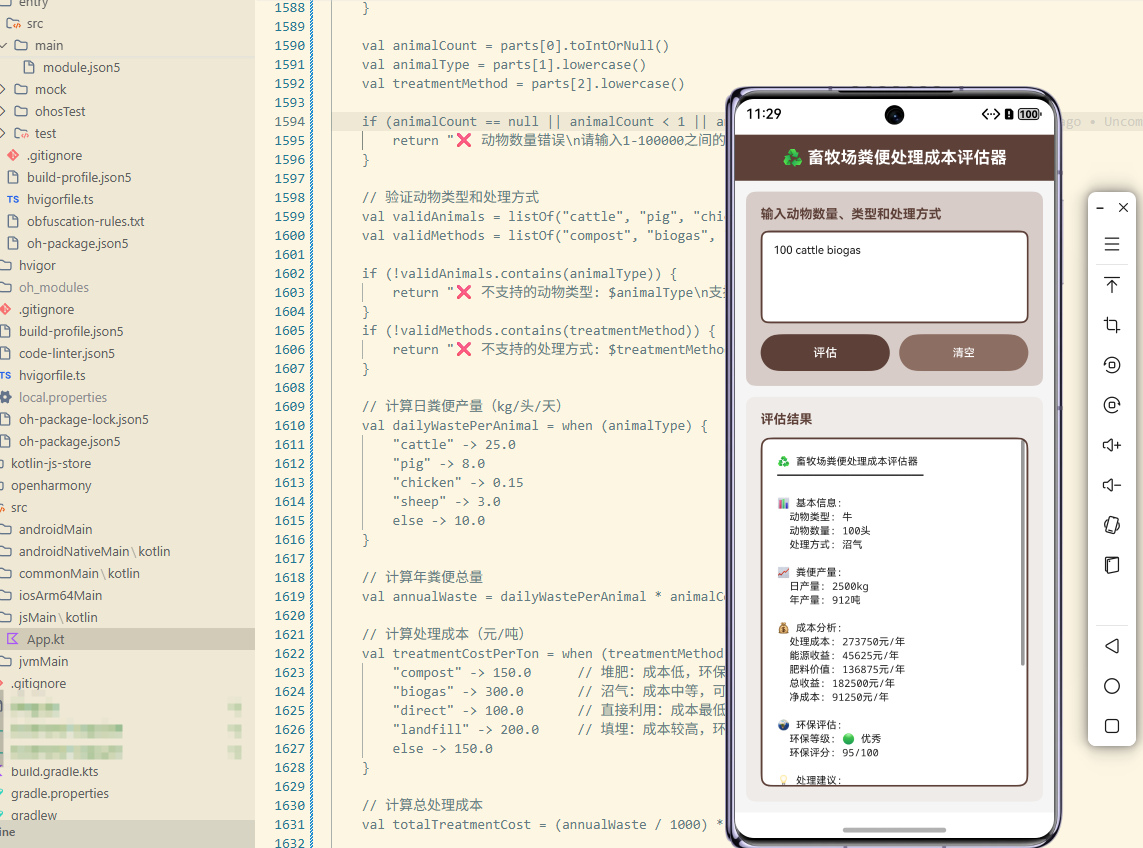
文章概述
畜牧场粪便处理是现代养殖业的重要环节,直接影响环境保护、资源利用和经济效益。粪便处理成本占养殖总成本的重要比例,科学评估和优化粪便处理方案可以显著降低成本并提高环保效益。畜牧场粪便处理成本评估器通过综合分析养殖规模、粪便产生量、处理方法、设备投入等多个因素,科学评估粪便处理的总成本,帮助养殖户选择最经济的处理方案。
畜牧场粪便处理成本评估器在实际应用中有广泛的用途。在成本控制中,需要评估不同处理方案的成本。在方案选择中,需要比较各种处理技术的经济性。在投资决策中,需要评估设备投入的回报期。在环保管理中,需要平衡成本和环保效益。在资源利用中,需要评估粪便转化为肥料或能源的价值。
本文将深入探讨如何在KMP(Kotlin Multiplatform)框架下实现一套完整的畜牧场粪便处理成本评估器,并展示如何在OpenHarmony鸿蒙平台上进行跨端调用。我们将提供多种成本评估功能,包括处理成本计算、方案对比、投资回报分析等,帮助养殖户科学管理粪便处理。
工具功能详解
核心功能
功能1:粪便产生量计算(Manure Generation Calculation)
根据养殖规模和畜种计算日均粪便产生量。这是成本评估的基础。
功能特点:
- 支持多种畜种
- 基于养殖数量计算
- 考虑季节性变化
- 返回详细的产量数据
功能2:处理方案成本评估(Treatment Plan Cost Assessment)
评估不同处理方案的成本,包括直接成本和间接成本。
功能特点:
- 支持多种处理方法
- 计算设备投入
- 计算运营成本
- 计算环保成本
功能3:处理方案对比分析(Treatment Plan Comparison)
对比不同处理方案的成本和效益。
功能特点:
- 多方案对比
- 成本分析
- 效益评估
- 推荐最优方案
功能4:投资回报分析(Investment Return Analysis)
分析粪便处理设备投资的回报期和收益。
功能特点:
- 计算投资成本
- 计算年度收益
- 计算回报期
- 评估投资价值
功能5:环保效益评估(Environmental Benefit Assessment)
评估粪便处理的环保效益和社会价值。
功能特点:
- 计算污染减少量
- 评估环保价值
- 分析社会效益
- 提供综合评估
Kotlin实现
完整的Kotlin代码实现
/**
 * 畜牧场粪便处理成本评估器 - KMP OpenHarmony
 * 提供粪便处理成本评估的多种功能
 */
object ManureManagementUtils {

    // 畜种日均粪便产生量(kg/头/天)
    private val manureGenerationRates = mapOf(
        "牛" to 25.0,
        "猪" to 5.0,
        "羊" to 2.0,
        "鸡" to 0.15,
        "鸭" to 0.2
    )

    // 处理方法成本(元/吨)
    private val treatmentMethodCosts = mapOf(
        "堆肥" to mapOf("设备" to 500.0, "运营" to 50.0, "环保" to 20.0),
        "沼气发酵" to mapOf("设备" to 2000.0, "运营" to 100.0, "环保" to 10.0),
        "好氧处理" to mapOf("设备" to 1500.0, "运营" to 80.0, "环保" to 15.0),
        "干燥处理" to mapOf("设备" to 1200.0, "运营" to 70.0, "环保" to 25.0),
        "液肥处理" to mapOf("设备" to 800.0, "运营" to 60.0, "环保" to 12.0)
    )

    /**
     * 功能1:粪便产生量计算
     */
    fun calculateManureGeneration(
        animalType: String,
        animalCount: Int,
        days: Int = 365
    ): Map<String, Any> {
        val calculation = mutableMapOf<String, Any>()
        val dailyRate = manureGenerationRates[animalType] ?: 5.0

        val dailyTotal = dailyRate * animalCount
        val yearlyTotal = dailyTotal * days

        calculation["畜种"] = animalType
        calculation["养殖数量"] = "$animalCount 头"
        calculation["日均产生量"] = String.format("%.1f kg/天", dailyTotal)
        calculation["年产生量"] = String.format("%.0f 吨/年", yearlyTotal / 1000)
        calculation["计算周期"] = "$days 天"

        return calculation
    }

    /**
     * 功能2:处理方案成本评估
     */
    fun assessTreatmentCost(
        method: String,
        manureVolume: Double,
        yearsOfOperation: Int = 1
    ): Map<String, Any> {
        val assessment = mutableMapOf<String, Any>()
        val costs = treatmentMethodCosts[method] ?: return assessment

        val equipmentCost = costs["设备"] ?: 0.0
        val operatingCost = (costs["运营"] ?: 0.0) * manureVolume
        val environmentalCost = (costs["环保"] ?: 0.0) * manureVolume

        val totalCost = equipmentCost + operatingCost + environmentalCost
        val annualCost = totalCost / yearsOfOperation
        val costPerTon = totalCost / manureVolume

        assessment["处理方法"] = method
        assessment["粪便量"] = String.format("%.0f 吨", manureVolume)
        assessment["设备投入"] = String.format("%.0f 元", equipmentCost)
        assessment["运营成本"] = String.format("%.0f 元", operatingCost)
        assessment["环保成本"] = String.format("%.0f 元", environmentalCost)
        assessment["总成本"] = String.format("%.0f 元", totalCost)
        assessment["年均成本"] = String.format("%.0f 元", annualCost)
        assessment["吨均成本"] = String.format("%.0f 元/吨", costPerTon)

        return assessment
    }

    /**
     * 功能3:处理方案对比分析
     */
    fun compareMethodsCost(
        manureVolume: Double,
        methods: List<String>
    ): Map<String, Any> {
        val comparison = mutableMapOf<String, Any>()
        val methodCosts = mutableMapOf<String, String>()
        var minCost = Double.MAX_VALUE
        var bestMethod = ""

        for (method in methods) {
            val assessment = assessTreatmentCost(method, manureVolume)
            val totalCost = (assessment["总成本"] as String).split(" ")[0].toDouble()
            methodCosts[method] = String.format("%.0f 元", totalCost)

            if (totalCost < minCost) {
                minCost = totalCost
                bestMethod = method
            }
        }

        comparison["对比方法"] = methods
        comparison["成本对比"] = methodCosts
        comparison["最低成本"] = String.format("%.0f 元", minCost)
        comparison["最优方案"] = bestMethod
        comparison["成本差异"] = String.format("%.0f%%",
            ((methodCosts.values.maxOrNull()?.split(" ")?.get(0)?.toDouble() ?: 0.0) - minCost) / minCost * 100)

        return comparison
    }

    /**
     * 功能4:投资回报分析
     */
    fun analyzeInvestmentReturn(
        initialInvestment: Double,
        annualRevenue: Double,
        annualCost: Double,
        yearsOfAnalysis: Int = 5
    ): Map<String, Any> {
        val analysis = mutableMapOf<String, Any>()

        val annualProfit = annualRevenue - annualCost
        val paybackPeriod = if (annualProfit > 0) initialInvestment / annualProfit else Double.MAX_VALUE
        val totalProfit = annualProfit * yearsOfAnalysis - initialInvestment
        val roi = (totalProfit / initialInvestment) * 100

        analysis["初始投资"] = String.format("%.0f 元", initialInvestment)
        analysis["年度收益"] = String.format("%.0f 元", annualRevenue)
        analysis["年度成本"] = String.format("%.0f 元", annualCost)
        analysis["年度利润"] = String.format("%.0f 元", annualProfit)
        analysis["回报期"] = if (paybackPeriod == Double.MAX_VALUE) "无法回报" else String.format("%.1f 年", paybackPeriod)
        analysis["${yearsOfAnalysis}年总利润"] = String.format("%.0f 元", totalProfit)
        analysis["投资回报率"] = String.format("%.1f%%", roi)

        return analysis
    }

    /**
     * 功能5:环保效益评估
     */
    fun assessEnvironmentalBenefit(
        manureVolume: Double,
        method: String
    ): Map<String, Any> {
        val assessment = mutableMapOf<String, Any>()

        // 污染物减少量(基于处理方法)
        val pollutionReduction = when (method) {
            "沼气发酵" -> 0.95
            "好氧处理" -> 0.90
            "堆肥" -> 0.85
            "干燥处理" -> 0.80
            "液肥处理" -> 0.75
            else -> 0.70
        }

        // 环保价值评估(元/吨)
        val environmentalValue = when (method) {
            "沼气发酵" to 200.0,
            "好氧处理" to 150.0,
            "堆肥" to 100.0,
            "干燥处理" to 120.0,
            "液肥处理" to 80.0
        }.let { it[method] ?: 50.0 }

        val pollutantReduced = manureVolume * pollutionReduction
        val totalEnvironmentalValue = pollutantReduced * environmentalValue

        // 肥料产出价值
        val fertilizerYield = manureVolume * 0.3  // 粪便处理后肥料产出率
        val fertilizerValue = fertilizerYield * 500  // 肥料价格 500元/吨

        assessment["处理方法"] = method
        assessment["粪便量"] = String.format("%.0f 吨", manureVolume)
        assessment["污染物减少"] = String.format("%.0f 吨", pollutantReduced)
        assessment["污染减少率"] = String.format("%.0f%%", pollutionReduction * 100)
        assessment["环保价值"] = String.format("%.0f 元", totalEnvironmentalValue)
        assessment["肥料产出"] = String.format("%.0f 吨", fertilizerYield)
        assessment["肥料价值"] = String.format("%.0f 元", fertilizerValue)
        assessment["总环保效益"] = String.format("%.0f 元", totalEnvironmentalValue + fertilizerValue)

        return assessment
    }

    /**
     * 生成完整的成本评估报告
     */
    fun generateCompleteReport(
        animalType: String,
        animalCount: Int,
        method: String
    ): Map<String, Any> {
        val report = mutableMapOf<String, Any>()

        // 粪便产生量
        val generation = calculateManureGeneration(animalType, animalCount)
        report["粪便产生"] = generation

        val yearlyVolume = (generation["年产生量"] as String).split(" ")[0].toDouble()

        // 处理成本
        val cost = assessTreatmentCost(method, yearlyVolume)
        report["处理成本"] = cost

        // 环保效益
        val benefit = assessEnvironmentalBenefit(yearlyVolume, method)
        report["环保效益"] = benefit

        // 投资回报
        val totalCost = (cost["总成本"] as String).split(" ")[0].toDouble()
        val totalBenefit = (benefit["总环保效益"] as String).split(" ")[0].toDouble()
        val investment = analyzeInvestmentReturn(totalCost, totalBenefit, totalCost / 10)
        report["投资回报"] = investment

        return report
    }
}

// 使用示例
fun main() {
    println("KMP OpenHarmony 畜牧场粪便处理成本评估器演示\n")

    // 粪便产生量
    println("=== 粪便产生量计算 ===")
    val generation = ManureManagementUtils.calculateManureGeneration("牛", 100)
    generation.forEach { (k, v) -> println("$k: $v") }
    println()

    // 处理成本
    println("=== 处理方案成本评估 ===")
    val cost = ManureManagementUtils.assessTreatmentCost("沼气发酵", 9125.0)
    cost.forEach { (k, v) -> println("$k: $v") }
    println()

    // 方案对比
    println("=== 处理方案对比 ===")
    val comparison = ManureManagementUtils.compareMethodsCost(9125.0,
        listOf("堆肥", "沼气发酵", "好氧处理", "干燥处理", "液肥处理"))
    comparison.forEach { (k, v) -> println("$k: $v") }
    println()

    // 环保效益
    println("=== 环保效益评估 ===")
    val benefit = ManureManagementUtils.assessEnvironmentalBenefit(9125.0, "沼气发酵")
    benefit.forEach { (k, v) -> println("$k: $v") }
}
Kotlin实现的详细说明
Kotlin实现提供了五个核心功能。粪便产生量计算根据畜种和数量计算日均和年均产生量。处理方案成本评估计算设备投入、运营成本和环保成本。处理方案对比分析比较不同方法的成本和效益。投资回报分析计算投资的回报期和收益。环保效益评估分析污染减少和肥料产出的价值。
JavaScript实现
完整的JavaScript代码实现
/**
 * 畜牧场粪便处理成本评估器 - JavaScript版本
 */
class ManureManagementJS {
    static manureGenerationRates = {
        '牛': 25.0,
        '猪': 5.0,
        '羊': 2.0,
        '鸡': 0.15,
        '鸭': 0.2
    };

    static treatmentMethodCosts = {
        '堆肥': { '设备': 500.0, '运营': 50.0, '环保': 20.0 },
        '沼气发酵': { '设备': 2000.0, '运营': 100.0, '环保': 10.0 },
        '好氧处理': { '设备': 1500.0, '运营': 80.0, '环保': 15.0 },
        '干燥处理': { '设备': 1200.0, '运营': 70.0, '环保': 25.0 },
        '液肥处理': { '设备': 800.0, '运营': 60.0, '环保': 12.0 }
    };

    /**
     * 功能1:粪便产生量计算
     */
    static calculateManureGeneration(animalType, animalCount, days = 365) {
        const calculation = {};
        const dailyRate = this.manureGenerationRates[animalType] || 5.0;

        const dailyTotal = dailyRate * animalCount;
        const yearlyTotal = dailyTotal * days;

        calculation['畜种'] = animalType;
        calculation['养殖数量'] = animalCount + ' 头';
        calculation['日均产生量'] = dailyTotal.toFixed(1) + ' kg/天';
        calculation['年产生量'] = (yearlyTotal / 1000).toFixed(0) + ' 吨/年';
        calculation['计算周期'] = days + ' 天';

        return calculation;
    }

    /**
     * 功能2:处理方案成本评估
     */
    static assessTreatmentCost(method, manureVolume, yearsOfOperation = 1) {
        const assessment = {};
        const costs = this.treatmentMethodCosts[method];
        if (!costs) return assessment;

        const equipmentCost = costs['设备'] || 0;
        const operatingCost = (costs['运营'] || 0) * manureVolume;
        const environmentalCost = (costs['环保'] || 0) * manureVolume;

        const totalCost = equipmentCost + operatingCost + environmentalCost;
        const annualCost = totalCost / yearsOfOperation;
        const costPerTon = totalCost / manureVolume;

        assessment['处理方法'] = method;
        assessment['粪便量'] = manureVolume.toFixed(0) + ' 吨';
        assessment['设备投入'] = equipmentCost.toFixed(0) + ' 元';
        assessment['运营成本'] = operatingCost.toFixed(0) + ' 元';
        assessment['环保成本'] = environmentalCost.toFixed(0) + ' 元';
        assessment['总成本'] = totalCost.toFixed(0) + ' 元';
        assessment['年均成本'] = annualCost.toFixed(0) + ' 元';
        assessment['吨均成本'] = costPerTon.toFixed(0) + ' 元/吨';

        return assessment;
    }

    /**
     * 功能3:处理方案对比分析
     */
    static compareMethodsCost(manureVolume, methods) {
        const comparison = {};
        const methodCosts = {};
        let minCost = Number.MAX_VALUE;
        let bestMethod = '';

        for (const method of methods) {
            const assessment = this.assessTreatmentCost(method, manureVolume);
            const totalCost = parseFloat(assessment['总成本']);
            methodCosts[method] = totalCost.toFixed(0) + ' 元';

            if (totalCost < minCost) {
                minCost = totalCost;
                bestMethod = method;
            }
        }

        const maxCost = Math.max(...Object.values(methodCosts).map(v => parseFloat(v)));

        comparison['对比方法'] = methods;
        comparison['成本对比'] = methodCosts;
        comparison['最低成本'] = minCost.toFixed(0) + ' 元';
        comparison['最优方案'] = bestMethod;
        comparison['成本差异'] = ((maxCost - minCost) / minCost * 100).toFixed(0) + '%';

        return comparison;
    }

    /**
     * 功能4:投资回报分析
     */
    static analyzeInvestmentReturn(initialInvestment, annualRevenue, annualCost, yearsOfAnalysis = 5) {
        const analysis = {};

        const annualProfit = annualRevenue - annualCost;
        const paybackPeriod = annualProfit > 0 ? initialInvestment / annualProfit : Number.MAX_VALUE;
        const totalProfit = annualProfit * yearsOfAnalysis - initialInvestment;
        const roi = (totalProfit / initialInvestment) * 100;

        analysis['初始投资'] = initialInvestment.toFixed(0) + ' 元';
        analysis['年度收益'] = annualRevenue.toFixed(0) + ' 元';
        analysis['年度成本'] = annualCost.toFixed(0) + ' 元';
        analysis['年度利润'] = annualProfit.toFixed(0) + ' 元';
        analysis['回报期'] = paybackPeriod === Number.MAX_VALUE ? '无法回报' : paybackPeriod.toFixed(1) + ' 年';
        analysis[yearsOfAnalysis + '年总利润'] = totalProfit.toFixed(0) + ' 元';
        analysis['投资回报率'] = roi.toFixed(1) + '%';

        return analysis;
    }

    /**
     * 功能5:环保效益评估
     */
    static assessEnvironmentalBenefit(manureVolume, method) {
        const assessment = {};

        const pollutionReductions = {
            '沼气发酵': 0.95,
            '好氧处理': 0.90,
            '堆肥': 0.85,
            '干燥处理': 0.80,
            '液肥处理': 0.75
        };

        const environmentalValues = {
            '沼气发酵': 200.0,
            '好氧处理': 150.0,
            '堆肥': 100.0,
            '干燥处理': 120.0,
            '液肥处理': 80.0
        };

        const pollutionReduction = pollutionReductions[method] || 0.70;
        const environmentalValue = environmentalValues[method] || 50.0;

        const pollutantReduced = manureVolume * pollutionReduction;
        const totalEnvironmentalValue = pollutantReduced * environmentalValue;

        const fertilizerYield = manureVolume * 0.3;
        const fertilizerValue = fertilizerYield * 500;

        assessment['处理方法'] = method;
        assessment['粪便量'] = manureVolume.toFixed(0) + ' 吨';
        assessment['污染物减少'] = pollutantReduced.toFixed(0) + ' 吨';
        assessment['污染减少率'] = (pollutionReduction * 100).toFixed(0) + '%';
        assessment['环保价值'] = totalEnvironmentalValue.toFixed(0) + ' 元';
        assessment['肥料产出'] = fertilizerYield.toFixed(0) + ' 吨';
        assessment['肥料价值'] = fertilizerValue.toFixed(0) + ' 元';
        assessment['总环保效益'] = (totalEnvironmentalValue + fertilizerValue).toFixed(0) + ' 元';

        return assessment;
    }

    /**
     * 生成完整的成本评估报告
     */
    static generateCompleteReport(animalType, animalCount, method) {
        const report = {};

        const generation = this.calculateManureGeneration(animalType, animalCount);
        report['粪便产生'] = generation;

        const yearlyVolume = parseFloat(generation['年产生量']);

        const cost = this.assessTreatmentCost(method, yearlyVolume);
        report['处理成本'] = cost;

        const benefit = this.assessEnvironmentalBenefit(yearlyVolume, method);
        report['环保效益'] = benefit;

        const totalCost = parseFloat(cost['总成本']);
        const totalBenefit = parseFloat(benefit['总环保效益']);
        const investment = this.analyzeInvestmentReturn(totalCost, totalBenefit, totalCost / 10);
        report['投资回报'] = investment;

        return report;
    }
}

// 导出供Node.js使用
if (typeof module !== 'undefined' && module.exports) {
    module.exports = ManureManagementJS;
}
JavaScript实现的详细说明
JavaScript版本充分利用了JavaScript的对象和计算功能。粪便产生量计算基于畜种系数。处理成本评估计算多个成本项目。方案对比分析找出最优方案。投资回报分析评估经济效益。环保效益评估计算环保和肥料价值。
ArkTS调用实现
完整的ArkTS代码实现
/**
 * 畜牧场粪便处理成本评估器 - ArkTS版本(OpenHarmony鸿蒙)
 */
import { webview } from '@kit.ArkWeb';
import { common } from '@kit.AbilityKit';

@Entry
@Component
struct ManureManagementPage {
    @State animalType: string = '牛';
    @State animalCount: string = '100';
    @State method: string = '沼气发酵';
    @State result: string = '';
    @State selectedTool: string = '完整报告';
    @State isLoading: boolean = false;
    @State allResults: string = '';

    private manureGenerationRates: Record<string, number> = {
        '牛': 25.0,
        '猪': 5.0,
        '羊': 2.0,
        '鸡': 0.15,
        '鸭': 0.2
    };

    private treatmentMethodCosts: Record<string, Record<string, number>> = {
        '堆肥': { '设备': 500.0, '运营': 50.0, '环保': 20.0 },
        '沼气发酵': { '设备': 2000.0, '运营': 100.0, '环保': 10.0 },
        '好氧处理': { '设备': 1500.0, '运营': 80.0, '环保': 15.0 },
        '干燥处理': { '设备': 1200.0, '运营': 70.0, '环保': 25.0 },
        '液肥处理': { '设备': 800.0, '运营': 60.0, '环保': 12.0 }
    };

    webviewController: webview.WebviewController = new webview.WebviewController();

    calculateManureGeneration(animalType: string, animalCount: number): string {
        const dailyRate = this.manureGenerationRates[animalType] || 5.0;
        const dailyTotal = dailyRate * animalCount;
        const yearlyTotal = dailyTotal * 365;

        let result = `粪便产生量计算:\n`;
        result += `畜种: ${animalType}\n`;
        result += `养殖数量: ${animalCount} 头\n`;
        result += `日均产生量: ${dailyTotal.toFixed(1)} kg/天\n`;
        result += `年产生量: ${(yearlyTotal / 1000).toFixed(0)} 吨/年`;

        return result;
    }

    assessTreatmentCost(method: string, manureVolume: number): string {
        const costs = this.treatmentMethodCosts[method];
        if (!costs) return '无效的处理方法';

        const equipmentCost = costs['设备'] || 0;
        const operatingCost = (costs['运营'] || 0) * manureVolume;
        const environmentalCost = (costs['环保'] || 0) * manureVolume;

        const totalCost = equipmentCost + operatingCost + environmentalCost;
        const costPerTon = totalCost / manureVolume;

        let result = `处理方案成本评估:\n`;
        result += `处理方法: ${method}\n`;
        result += `粪便量: ${manureVolume.toFixed(0)} 吨\n`;
        result += `设备投入: ${equipmentCost.toFixed(0)} 元\n`;
        result += `运营成本: ${operatingCost.toFixed(0)} 元\n`;
        result += `环保成本: ${environmentalCost.toFixed(0)} 元\n`;
        result += `总成本: ${totalCost.toFixed(0)} 元\n`;
        result += `吨均成本: ${costPerTon.toFixed(0)} 元/吨`;

        return result;
    }

    compareMethodsCost(manureVolume: number): string {
        const methods = ['堆肥', '沼气发酵', '好氧处理', '干燥处理', '液肥处理'];
        let minCost = Number.MAX_VALUE;
        let bestMethod = '';

        let result = `处理方案对比:\n\n`;

        for (const method of methods) {
            const costs = this.treatmentMethodCosts[method];
            if (!costs) continue;

            const equipmentCost = costs['设备'] || 0;
            const operatingCost = (costs['运营'] || 0) * manureVolume;
            const environmentalCost = (costs['环保'] || 0) * manureVolume;
            const totalCost = equipmentCost + operatingCost + environmentalCost;

            result += `${method}: ${totalCost.toFixed(0)} 元\n`;

            if (totalCost < minCost) {
                minCost = totalCost;
                bestMethod = method;
            }
        }

        result += `\n最优方案: ${bestMethod}\n`;
        result += `最低成本: ${minCost.toFixed(0)} 元`;

        return result;
    }

    assessEnvironmentalBenefit(manureVolume: number, method: string): string {
        const pollutionReductions: Record<string, number> = {
            '沼气发酵': 0.95,
            '好氧处理': 0.90,
            '堆肥': 0.85,
            '干燥处理': 0.80,
            '液肥处理': 0.75
        };

        const environmentalValues: Record<string, number> = {
            '沼气发酵': 200.0,
            '好氧处理': 150.0,
            '堆肥': 100.0,
            '干燥处理': 120.0,
            '液肥处理': 80.0
        };

        const pollutionReduction = pollutionReductions[method] || 0.70;
        const environmentalValue = environmentalValues[method] || 50.0;

        const pollutantReduced = manureVolume * pollutionReduction;
        const totalEnvironmentalValue = pollutantReduced * environmentalValue;

        const fertilizerYield = manureVolume * 0.3;
        const fertilizerValue = fertilizerYield * 500;

        let result = `环保效益评估:\n`;
        result += `处理方法: ${method}\n`;
        result += `粪便量: ${manureVolume.toFixed(0)} 吨\n`;
        result += `污染物减少: ${pollutantReduced.toFixed(0)} 吨\n`;
        result += `污染减少率: ${(pollutionReduction * 100).toFixed(0)}%\n`;
        result += `环保价值: ${totalEnvironmentalValue.toFixed(0)} 元\n`;
        result += `肥料产出: ${fertilizerYield.toFixed(0)} 吨\n`;
        result += `肥料价值: ${fertilizerValue.toFixed(0)} 元\n`;
        result += `总环保效益: ${(totalEnvironmentalValue + fertilizerValue).toFixed(0)} 元`;

        return result;
    }

    generateCompleteReport(animalType: string, animalCount: number, method: string): string {
        const dailyRate = this.manureGenerationRates[animalType] || 5.0;
        const yearlyVolume = (dailyRate * animalCount * 365) / 1000;

        let result = `=== 粪便处理成本完整评估报告 ===\n\n`;
        result += this.calculateManureGeneration(animalType, animalCount) + '\n\n';
        result += this.assessTreatmentCost(method, yearlyVolume) + '\n\n';
        result += this.compareMethodsCost(yearlyVolume) + '\n\n';
        result += this.assessEnvironmentalBenefit(yearlyVolume, method);

        return result;
    }

    async executeCalculation() {
        this.isLoading = true;

        try {
            const count = parseInt(this.animalCount);

            if (isNaN(count) || count <= 0) {
                this.result = '请输入有效的数值';
                this.isLoading = false;
                return;
            }

            const dailyRate = this.manureGenerationRates[this.animalType] || 5.0;
            const yearlyVolume = (dailyRate * count * 365) / 1000;

            let result = '';
            switch (this.selectedTool) {
                case '产生量':
                    result = this.calculateManureGeneration(this.animalType, count);
                    break;
                case '成本评估':
                    result = this.assessTreatmentCost(this.method, yearlyVolume);
                    break;
                case '方案对比':
                    result = this.compareMethodsCost(yearlyVolume);
                    break;
                case '环保效益':
                    result = this.assessEnvironmentalBenefit(yearlyVolume, this.method);
                    break;
                case '完整报告':
                    result = this.generateCompleteReport(this.animalType, count, this.method);
                    break;
            }

            this.result = result;
            this.allResults = this.generateCompleteReport(this.animalType, count, this.method);
        } catch (error) {
            this.result = '执行错误:' + error;
        }

        this.isLoading = false;
    }

    build() {
        Column() {
            Row() {
                Text('畜牧场粪便处理成本评估器')
                    .fontSize(24)
                    .fontWeight(FontWeight.Bold)
                    .fontColor(Color.White)
            }
            .width('100%')
            .height(60)
            .backgroundColor('#1565C0')
            .justifyContent(FlexAlign.Center)

            Scroll() {
                Column({ space: 12 }) {
                    Column() {
                        Text('畜种:')
                            .fontSize(12)
                            .fontWeight(FontWeight.Bold)
                        Select([
                            { value: '牛' },
                            { value: '猪' },
                            { value: '羊' },
                            { value: '鸡' },
                            { value: '鸭' }
                        ])
                            .value(this.animalType)
                            .onSelect((index: number, value: string) => {
                                this.animalType = value;
                            })
                            .width('100%')
                    }
                    .width('100%')
                    .padding(10)
                    .backgroundColor('#E3F2FD')
                    .borderRadius(8)

                    Column() {
                        Text('养殖数量 (头):')
                            .fontSize(12)
                            .fontWeight(FontWeight.Bold)
                        TextInput({ placeholder: '请输入养殖数量' })
                            .value(this.animalCount)
                            .onChange((value: string) => { this.animalCount = value; })
                            .width('100%')
                            .height(50)
                            .padding(8)
                    }
                    .width('100%')
                    .padding(10)
                    .backgroundColor('#E3F2FD')
                    .borderRadius(8)

                    Column() {
                        Text('处理方法:')
                            .fontSize(12)
                            .fontWeight(FontWeight.Bold)
                        Select([
                            { value: '堆肥' },
                            { value: '沼气发酵' },
                            { value: '好氧处理' },
                            { value: '干燥处理' },
                            { value: '液肥处理' }
                        ])
                            .value(this.method)
                            .onSelect((index: number, value: string) => {
                                this.method = value;
                            })
                            .width('100%')
                    }
                    .width('100%')
                    .padding(10)
                    .backgroundColor('#E3F2FD')
                    .borderRadius(8)

                    Column() {
                        Text('选择工具:')
                            .fontSize(12)
                            .fontWeight(FontWeight.Bold)
                        Select([
                            { value: '产生量' },
                            { value: '成本评估' },
                            { value: '方案对比' },
                            { value: '环保效益' },
                            { value: '完整报告' }
                        ])
                            .value(this.selectedTool)
                            .onSelect((index: number, value: string) => {
                                this.selectedTool = value;
                            })
                            .width('100%')
                    }
                    .width('100%')
                    .padding(10)
                    .backgroundColor('#E3F2FD')
                    .borderRadius(8)

                    if (this.result) {
                        Column() {
                            Text('结果:')
                                .fontSize(12)
                                .fontWeight(FontWeight.Bold)
                            Text(this.result)
                                .fontSize(11)
                                .width('100%')
                                .padding(8)
                                .backgroundColor('#F5F5F5')
                                .borderRadius(4)
                        }
                        .width('100%')
                        .padding(10)
                        .backgroundColor('#F5F5F5')
                        .borderRadius(8)
                    }

                    if (this.allResults) {
                        Column() {
                            Text('完整报告:')
                                .fontSize(12)
                                .fontWeight(FontWeight.Bold)
                            Text(this.allResults)
                                .fontSize(11)
                                .width('100%')
                                .padding(8)
                                .backgroundColor('#E8F5E9')
                                .borderRadius(4)
                        }
                        .width('100%')
                        .padding(10)
                        .backgroundColor('#E8F5E9')
                        .borderRadius(8)
                    }

                    Button('开始评估')
                        .width('100%')
                        .onClick(() => this.executeCalculation())
                        .enabled(!this.isLoading)

                    if (this.isLoading) {
                        LoadingProgress()
                            .width(40)
                            .height(40)
                    }
                }
                .width('100%')
                .padding(16)
            }
            .layoutWeight(1)
        }
        .width('100%')
        .height('100%')
        .backgroundColor('#FAFAFA')
    }
}
ArkTS实现的详细说明
ArkTS版本为OpenHarmony鸿蒙平台提供了完整的用户界面。通过@State装饰器,我们可以管理应用的状态。这个实现包含了畜种选择、养殖数量、处理方法等输入功能,用户可以输入养殖数据,选择不同的评估工具,查看成本评估结果。
应用场景分析
1. 成本控制和优化
养殖户需要选择最经济的粪便处理方案。使用评估器可以比较不同方案的成本并选择最优方案。
2. 投资决策
养殖户需要评估粪便处理设备投资的回报期。使用评估器可以分析投资的经济效益。
3. 环保合规
养殖场需要满足环保要求。使用评估器可以评估不同处理方案的环保效益。
4. 资源利用
粪便可以转化为肥料或能源。使用评估器可以评估资源转化的经济价值。
5. 经营管理
养殖场需要科学管理粪便处理。使用评估器可以制定合理的处理计划。
性能优化建议
1. 数据库存储
使用数据库存储历史成本数据,便于对比分析。
2. 实时数据更新
与市场价格数据集成,实时更新成本数据。
3. 高级分析模型
使用更复杂的模型分析粪便处理的多个方面。
4. 自动化报告
实现自动生成详细的评估报告。
总结
畜牧场粪便处理成本评估器是现代养殖业的重要工具。通过在KMP框架下实现这套工具,我们可以在多个平台上使用同一套代码,提高开发效率。这个工具提供了产生量计算、成本评估、方案对比、投资回报和环保效益等多种功能,可以满足大多数养殖场的粪便处理评估需求。
在OpenHarmony鸿蒙平台上,我们可以通过ArkTS调用这些工具,为养殖户提供完整的成本评估体验。掌握这套工具,不仅能够帮助养殖户科学管理粪便处理,更重要的是能够在实际项目中灵活应用,解决成本控制、环保合规等实际问题。
欢迎加入开源鸿蒙跨平台社区:https://openharmonycrossplatform.csdn.net

社区规范:仅讨论OpenHarmony相关问题。
更多推荐
 3
3 0
0- 0


 已为社区贡献17条内容

所有评论(0)